The Vanishing Counter: What Patients Lose — and Gain — When the Pharmacist Becomes an App
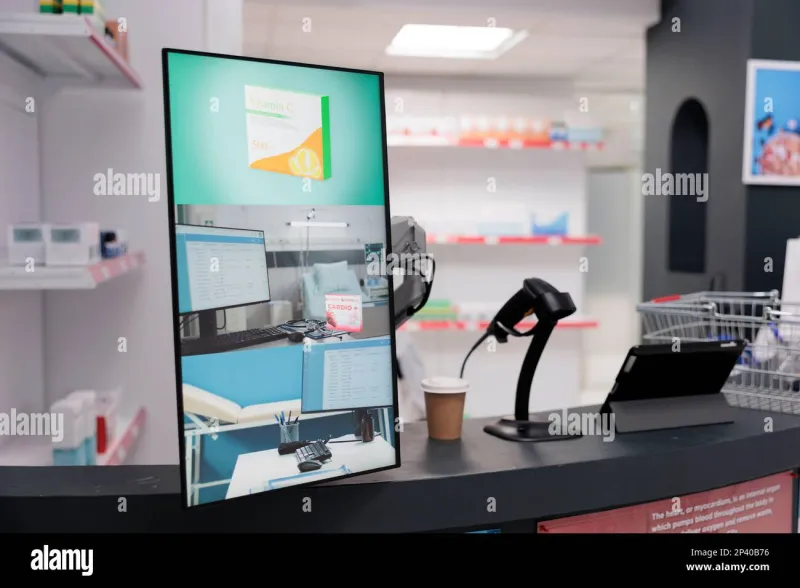
Photo: empty pharmacy counter with computer screen and pill bottles, via c8.alamy.com
There is a conversation that has quietly anchored American healthcare for a century. It happens at a counter, often without an appointment, and it begins with a question as simple as 'got a minute?' The pharmacist looks up from the vials, and for two or three minutes, a patient gets answers no one else in the healthcare system has time to give.
As medication delivery becomes the default for millions of Americans, that conversation is being replaced. In its place: an app, a chatbot, a toll-free number with a hold queue. Whether this is progress or loss depends on which questions you ask — and on whether patients know what to ask at all.
What the Machine Does Well
Let the record show that the digital pharmacist never has a bad day. Automated systems check drug interactions against a patient's full medication list with tireless consistency. They flag duplicate therapies, allergy conflicts, and dosing anomalies that a hurried human behind a busy counter might miss. For routine refills of a stable, well-tolerated maintenance medication, a pharmacist consultation adds little clinical value — and removing it removes friction that causes patients to abandon therapy.
Digital platforms also make information more accessible in one respect: a patient too embarrassed to ask a question aloud about a sensitive medication may type it freely into a chat window. Anonymity has its own therapeutic value.
What the Machine Cannot See
But consultation is not merely the transfer of information. A good pharmacist reads things a form cannot capture: the hesitation before a patient says 'I'm fine,' the tremor that suggests a dose problem, the confusion that signals a medication is being taken incorrectly. Studies of pharmacist interventions consistently show that face-to-face counseling catches adherence problems and administration errors that software does not.
There is also an accountability question. When something goes wrong — a wrong drug, a misread dose — a named professional behind a counter is answerable in person. A chatbot's terms of service are a colder consolation.
The Questions Patients Should Ask Before Going Fully Remote
Patients moving to a delivery or mail-order pharmacy should treat the transition as an interview. Ask:
- Can I speak to a licensed pharmacist on demand? Not a technician, not a script reader — a pharmacist, by phone or video, within a reasonable time.
- Who reviews my full medication history? A centralized record is only valuable if a human actually examines it.
- What happens when the system flags a problem? Is there a call from a professional, or a notification I might dismiss?
- How do I report a side effect or an error — and who responds?
- Can I get a live consultation when starting a new medication, the moment when counseling matters most?
A Hybrid Future, Not a Binary One
The honest answer is that neither model is sufficient alone. The counter conversation was always rationed — three minutes, in a busy store, between other customers. Digital pharmacy can offer more thorough written guidance, proactive interaction checks, and unlimited patience. What it must not offer is a system in which no human is ever reachable when it counts.
The right standard is simple: convenience for the routine, a human for the consequential. Patients should settle for nothing less.